
Creatine guide
A practical guide to creatine monohydrate: who it helps, who can skip it, how to dose it, and how to handle safety myths.
Quick answer
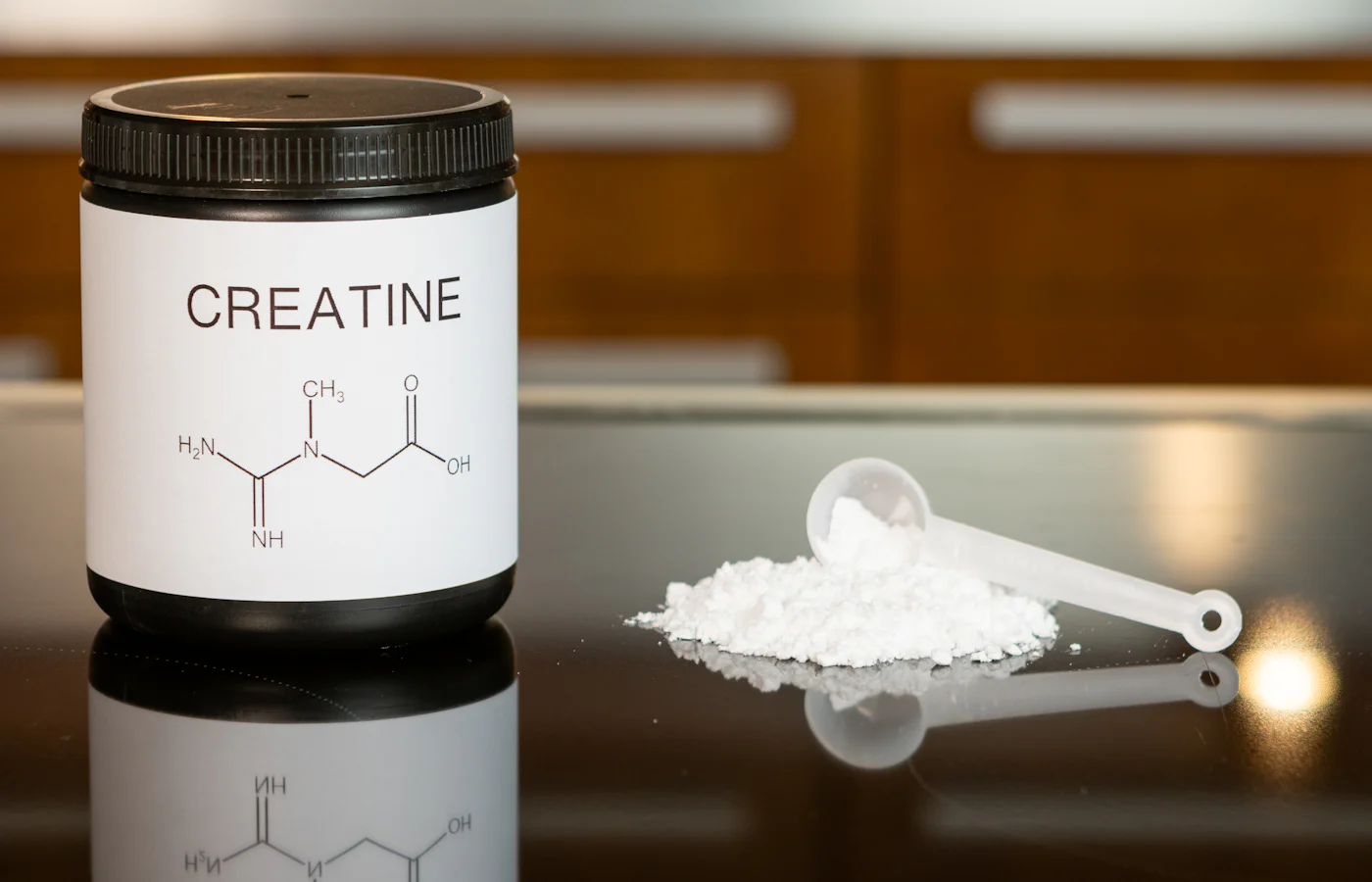
Creatine monohydrate is a well-supported supplement for repeated high-intensity work, strength and power training, and helping muscles stay stocked with phosphocreatine. It is not a steroid, not a fat burner, and not required to build muscle.
The simple default is 3-5 g of creatine monohydrate once per day, including rest days. Loading is optional: 20 g/day split into four 5 g servings for 5-7 days, then 3-5 g/day. Skipping the loading phase just means saturation takes longer.
It is most worth considering when your training already includes repeated hard efforts and the basics are handled. Endurance-only goals, inconsistent training, tight budgets, stomach intolerance, or dislike of scale-weight changes are all valid reasons to skip it.
The practical choice for most healthy adult lifters is boring creatine monohydrate. Exotic forms, gummies, stacks, and recovery blends need their own product-level proof instead of borrowing credibility from monohydrate research.
The big safety myths are usually overblown for healthy adults: current evidence does not show creatine causing hair loss or damaging healthy kidneys. The cautious lane stays open for kidney disease, abnormal labs, pregnancy, complex medication use, and clinician-managed conditions.
How to use this guide
- Use this guide when deciding whether creatine is worth adding after training, calories, protein, sleep, and consistency are already mostly handled.
- Treat creatine as an optional small edge, not a rescue plan for bad programming or low effort.
- If you have kidney disease, unexplained abnormal labs, pregnancy, bipolar disorder, complex medication use, or clinician-managed health conditions, get medical guidance before self-clearing a supplement.
- What creatine actually helps
- Choose the boring form first
- Dose it simply and consistently
- Handle hair-loss and kidney myths
What this does not prove
Short-term physiology, EMG, mechanism, and acute-fatigue evidence can inform choices, but it should not be treated as final proof of long-term results.
- Many creatine studies are short and are not designed to detect rare adverse events.
- The strongest performance evidence is for high-intensity and repeated-effort contexts, not every sport or goal.
- Hair-loss evidence is improved by the 2025 trial but still limited for women, older adults, people with active androgenetic alopecia, and long-term use.
- Kidney reassurance is strongest for healthy adults; chronic kidney disease and abnormal lab contexts are different.
- Product-level quality, contamination, and co-ingredient risk can change the practical safety answer.
Who this is for / not for
- Use this as general education and training planning, not as medical care, diagnosis, individualized rehab, sport-return clearance, or a prescription.
- Beginners should keep the rules conservative and repeatable before chasing advanced intensity, volume, or exercise variations.
- Pain, recent injury, pregnancy or postpartum restrictions, cardiac symptoms, fainting, neurological symptoms, medication constraints, kidney disease, eating-disorder history, or clinician-managed weight loss should change the plan with qualified guidance.
What to do
Start with the job creatine can actually do
Creatine helps replenish the phosphocreatine system that supports short, hard efforts. That is why the best fitness case is repeated high-intensity work: lifting sets, sprints, jumps, hard intervals, and training blocks where a little more repeatable output can matter.
The case is weaker when the sport or goal is mostly long steady endurance, when extra water-weight is a problem for weight-class or running economy, or when training is too inconsistent for a small capacity edge to matter.
It does not directly burn fat, replace progressive training, or turn a low-protein diet into a muscle-building plan. If the basics are missing, creatine is not the missing adult in the room.
- Useful fit: lifting, sprinting, jumping, repeated hard efforts, strength and power goals.
- Weaker fit: expecting direct fat loss, detox, hormone changes, or tendon repair.
- Best expectation: small support for training capacity and adaptation, not a dramatic transformation.
Choose creatine monohydrate before fancy forms
The ISSN position stand identifies creatine monohydrate as the most studied and effective form for increasing muscle creatine and supporting high-intensity exercise capacity.
Different forms may sound more advanced, but the useful question is whether they outperform ordinary monohydrate in human outcome data. Most marketing does not clear that bar.
For product checks, match the label to the actual serving: creatine form, grams of creatine per serving, number of servings needed to reach a real daily dose, third-party certification, co-ingredients, allergens, sweeteners, and cost per evidence-matched dose.
- Look for creatine monohydrate as the active ingredient.
- Check whether one serving actually delivers 3-5 g of creatine or just a small token amount.
- Prefer clear labeling over proprietary blends.
- For drug-tested athletes, favor batch-specific sport certification; a clean-looking label or generic badge is not the same as low risk.
- Do not pay extra for a form just because the label uses more science words.
- Creatine gummies vs powder — Why format and label math matter more than candy-shaped marketing.
- Supplement evidence guide — The broader checklist for ingredient, dose, outcome, and safety claims.
Use a boring daily dose
For most healthy adult lifters, the practical maintenance dose is 3-5 g of creatine monohydrate every day. Take it on training days and rest days; creatine works by keeping muscle stores topped up over time, not by acting like a pre-workout stimulant.
Loading can saturate stores faster, but it is optional. The common loading approach is 20 g/day for 5-7 days, split into four 5 g servings, then 3-5 g/day after that. If you skip loading and just take 3-5 g/day, you usually get to the same place more gradually.
Taking it near training, with a meal, or whenever you remember can all be reasonable if the habit is consistent. The exact minute is not the main lever.
- Default plan: 3-5 g creatine monohydrate once daily.
- Optional faster-start plan: 20 g/day for 5-7 days, split into smaller servings, then 3-5 g/day.
- Keep taking it on rest days if you want muscle stores to stay saturated.
- Pick a repeatable daily habit instead of a complicated cycle.
- Expect some scale-weight gain from water stored with muscle creatine, not instant fat gain.
- Drink normally, train normally, and stop turning supplement timing into theater.
- If stomach upset happens, simplify the product and take it with food or split the serving.
Separate safety signals from internet panic
The hair-loss story mostly grew from a small 2009 DHT marker study. A 2025 placebo-controlled trial that directly measured hair outcomes in resistance-trained men did not find a hair-loss signal over 12 weeks.
The kidney story often confuses creatinine, a lab marker, with kidney damage. Human trials and a 2025 meta-analysis do not show a kidney-function harm signal in healthy adults, but creatine can complicate creatinine-based lab interpretation.
- Hair loss: current direct evidence does not support creatine as the cause, but long-term and at-risk subgroup data are still limited.
- Kidneys: healthy-adult evidence is reassuring; existing kidney disease or abnormal labs need clinician interpretation.
- Labs: tell your clinician about creatine use if kidney markers are being interpreted.
- Products: creatine monohydrate evidence does not protect a contaminated blend or mystery supplement.
- Creatine and hair loss claim — The short verdict on the DHT and hair-loss rumor.
- Creatine kidney claim — Why creatinine labs are not the same as kidney damage.
How it looks in practice
Beginner lifter with inconsistent training
Creatine can be fine, but it is not the priority. A repeatable program, enough protein, and sleep will do more than a tub on the counter.
Add creatine only if it is easy and affordable, not because missing it makes the plan unserious.
Experienced lifter chasing small edges
This is the clean use case: a consistent lifter doing hard sets may benefit from slightly better repeat high-intensity output over time.
Keep the product boring, track training performance, and do not expect visible changes in a week beyond possible water-weight movement.
Reader worried about kidney labs
Do not let social media interpret labs for you. Creatine can affect creatinine-based readings without proving kidney injury, but abnormal labs deserve clinician context.
Bring the supplement label and timeline to the appointment so the lab discussion is grounded in reality.
Teen athlete in tested sport
Creatine as an ingredient is not banned by default, but the finished product is the risk. A contaminated, mislabeled, or reformulated supplement can create a sport-rule problem even when creatine itself is ordinary.
Use parent, coach, clinician, and sport-organization guidance before buying. If a supplement is used in a tested sport, choose batch-specific sport certification and keep the exact label and lot information.
Common questions
Is creatine a steroid?
No. Creatine is a dietary compound involved in rapid energy recycling. It is not an anabolic steroid and does not work like testosterone or other hormones.
Will creatine make me gain fat?
Creatine can increase scale weight through water stored with muscle creatine. That is not the same as fat gain. Fat gain still comes from sustained energy surplus.
Do I need to cycle creatine?
For normal healthy-adult fitness use, cycling is usually more ritual than requirement. The stronger evidence base is around consistent creatine monohydrate use, not elaborate on-off protocols.
How much creatine should I take?
The usual practical dose is 3-5 g of creatine monohydrate per day. A loading phase is optional: 20 g/day split into four 5 g servings for 5-7 days, then 3-5 g/day. Consistency matters more than the exact time of day.
Is creatine mandatory for muscle gain?
No. It can help some training outcomes, but muscle gain still comes from progressive training, enough food and protein, recovery, and time.
Who gets the least from creatine?
People doing mostly steady endurance work, people not training consistently, readers who dislike water-weight changes, and anyone who cannot tolerate or afford it can skip creatine without making their plan unserious.
Common mistakes
- Buying expensive forms before trying ordinary creatine monohydrate.
- Expecting creatine to cause direct fat loss or visible muscle gain without better training.
- Panicking over a small scale jump that is likely water, glycogen, food, or normal fluctuation.
- Using hair-loss or kidney TikToks as if they outrank direct human evidence and clinician lab interpretation.
- Assuming a creatine blend, gummy, pre-workout, or recovery stack has the same evidence as plain monohydrate.
- Ignoring serving math, co-ingredients, and batch-specific certification when competing in sport or when product quality matters.
Caveats
- This guide is general education for fitness readers, not medical advice.
- Kidney disease, abnormal kidney labs, pregnancy, bipolar disorder, complex medication use, dehydration risk, eating-disorder history, and clinician-managed conditions need individualized guidance.
- Healthy-adult safety evidence does not automatically apply to chronic kidney disease, pregnancy, every medication context, or contaminated products.
- Some people get GI discomfort or dislike the water-weight change. Optional means optional.
- Children and teenagers should use parent, clinician, coach, and sport-organization guidance rather than adult supplement habits copied online.
Why the answer looks like this
Creatine monohydrate has unusually strong supplement evidence for high-intensity exercise support, but the honest answer stays bounded: useful in the right training context, optional, not a steroid, and not proof for every creatine-adjacent product or myth.
Creatine monohydrate is the evidence anchor
The ISSN position stand describes creatine monohydrate as the most effective ergogenic nutritional supplement currently available for increasing high-intensity exercise capacity and lean body mass during training.
The same position stand describes a fast loading protocol of 5 g four times daily for 5-7 days, or a slower approach of 3 g/day for about 28 days. In practical fitness copy, that supports the common maintenance target of roughly 3-5 g/day after loading or as a simple daily routine.
That is a strong statement for a supplement, but it is still specific: monohydrate, studied populations, exercise outcomes, and training context. It should not be stretched into fat-loss, hormone, detox, or injury-healing claims.
The form matters
The same position stand notes that the vast majority of efficacy studies use creatine monohydrate and that claims for superior uptake or retention from other forms are not well supported.
NIH ODS summarizes the same practical point: creatine monohydrate is the most widely used and studied form, while more expensive alternatives have not been proven superior for muscle creatine, digestibility, stability, or safety.
For readers, that means the boring form is the default until a different form proves it improves meaningful outcomes, not just label appeal.
Hair-loss evidence is weaker than the rumor
The 2009 rugby-player study measured hormones, not hair loss. It can explain why DHT talk entered the conversation, but it does not prove follicle miniaturization or clinical shedding.
The 2025 randomized trial directly measured hair density, hair count, follicular units, cumulative thickness, and androgen markers over 12 weeks in resistance-trained men and did not find a creatine hair-loss signal. The limitation is that one short male-only trial does not settle every long-term or high-risk subgroup.
Kidney claims need lab nuance
A 2025 systematic review/meta-analysis and healthy-adult trials do not show creatine causing kidney-function damage in the studied populations.
The recurring confusion is that creatine can affect serum creatinine, and creatinine-based estimates can be influenced by non-kidney factors. That is why people with abnormal labs or kidney disease need clinician interpretation rather than influencer reassurance.
Supplement regulation still matters
FDA consumer guidance explains that dietary supplements are regulated differently from drugs and are not approved for safety and effectiveness before marketing in the same way.
USADA makes the athlete version of this point sharper: ingredient status is not the same as finished-product safety, because supplement labels can be wrong, contaminated, or changed between batches.
Creatine monohydrate may be well supported, but that does not make every product clean, accurately labeled, correctly dosed, or free from problematic co-ingredients.
Limitations
- Many creatine studies are short and are not designed to detect rare adverse events.
- The strongest performance evidence is for high-intensity and repeated-effort contexts, not every sport or goal.
- Hair-loss evidence is improved by the 2025 trial but still limited for women, older adults, people with active androgenetic alopecia, and long-term use.
- Kidney reassurance is strongest for healthy adults; chronic kidney disease and abnormal lab contexts are different.
- Product-level quality, contamination, and co-ingredient risk can change the practical safety answer.
Related reading and tools
- Supplement evidence guide — Use the broader framework for any supplement claim.
- Creatine is not a steroid — A short article separating creatine from hormone panic.
- Creatine gummies vs powder — How to check label math and product format.
- Creatine and collagen stack — Why combining ingredients does not automatically prove a recovery stack.
- Creatine glossary — A plain-language definition and related pages.
References
- Kreider et al. ISSN position stand: safety and efficacy of creatine supplementation (2017)
- Kreider et al. Common questions and misconceptions about creatine supplementation: what does the scientific evidence really show? (2021)
- van der Merwe et al. Three weeks of creatine monohydrate supplementation affects dihydrotestosterone to testosterone ratio in college-aged rugby players (2009)
- Lak et al. Does creatine cause hair loss? A 12-week randomized controlled trial (2025)
- Kabiri Naeini et al. Effect of creatine supplementation on kidney function: a systematic review and meta-analysis (2025)
- Lugaresi et al. Does creatine supplementation impair kidney function in healthy subjects on a high-protein diet? (2013)
- National Kidney Foundation: Creatinine
- FDA 101: Dietary Supplements
- NIH ODS: Dietary Supplements for Exercise and Athletic Performance - Health Professional Fact Sheet
- USADA: Supplement Connect
- ConsumerLab: How Products Were Evaluated in the Creatine Supplements Review